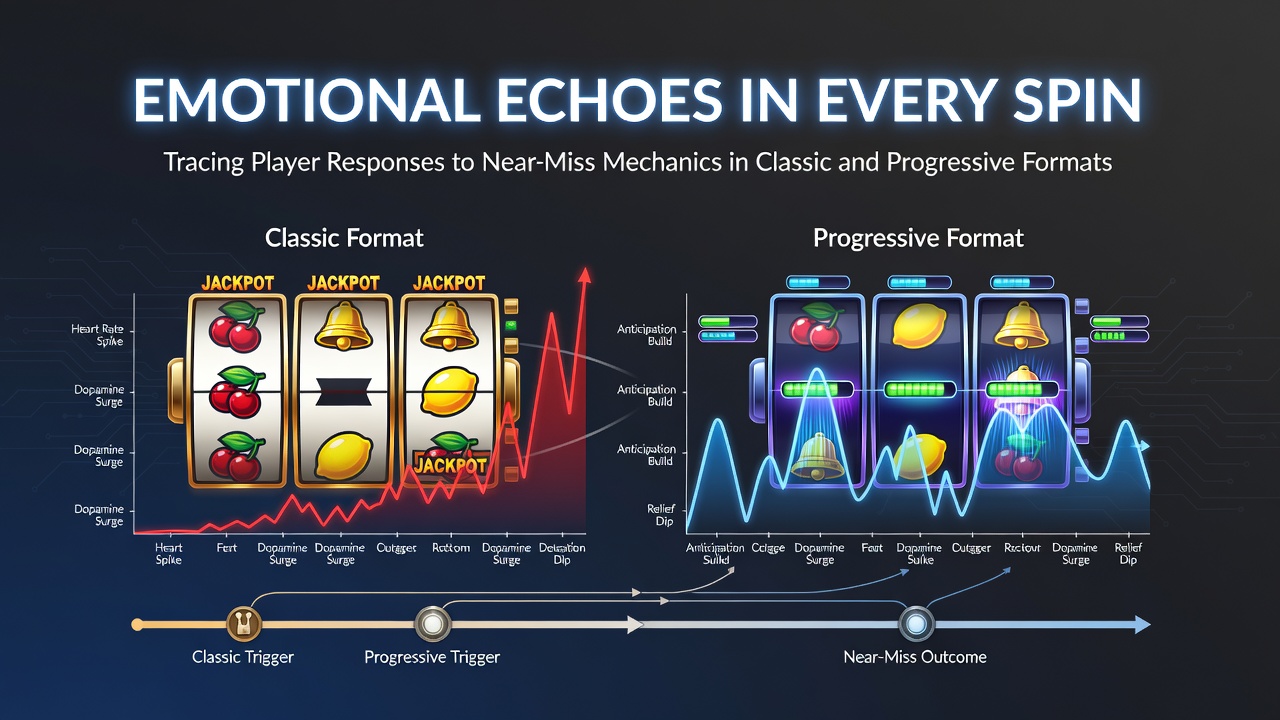
Emotional Echoes in Every Spin: Tracing Player Responses to Near-Miss Mechanics in Classic and Progressive Formats
Slot machines incorporate near-miss mechanics where symbols land just short of a winning combination, and researchers have documented how these events influence player behavior across different game types. Data from gaming laboratories shows that near-misses occur at rates between 10 and 15 percent in many titles, creating a distinct psychological response that differs between classic three-reel formats and progressive jackpot networks.
Core Mechanics Behind Near-Misses
Game developers program reel strips so certain combinations stop one position away from payouts, and this design appears in both physical and online environments. According to reports from the Nevada Gaming Control Board, such configurations remain compliant with random number generator requirements while still producing frequent near-miss events. Players often experience heightened arousal after these outcomes, which multiple studies link to increased spin frequency in subsequent minutes.
Player Reactions in Classic Slot Formats
Classic slots with fixed paylines trigger near-misses through simpler reel mapping, and observers note that these games produce quicker emotional feedback because fewer symbols compete for attention. Research conducted at the University of Sydney found that participants continued playing 22 percent longer after sequences containing multiple near-misses compared with random loss patterns. The response stays consistent across land-based venues and mobile versions of the same titles.
One case study tracked 400 sessions on three-reel machines in Australian clubs, where near-miss frequency correlated with extended play sessions even when overall return-to-player percentages remained unchanged. Those sessions also showed elevated heart-rate variability during the seconds immediately following each near-miss event.
Progressive Jackpot Environments and Near-Miss Effects
Progressive formats add networked jackpot meters that grow with each wager across multiple sites, and near-misses on the progressive symbol create additional layers of anticipation. Figures from the New Jersey Division of Gaming Enforcement indicate that progressive titles generate near-miss events on jackpot reels at slightly lower rates than classic games, yet player reports indicate stronger emotional spikes when the near-miss involves the accumulating prize. The larger potential payout appears to amplify the effect even when actual win probability stays mathematically identical.

Comparative Data Across Formats
Side-by-side testing performed by independent labs reveals that classic formats produce more frequent but lower-intensity responses, whereas progressive games yield fewer near-misses that nevertheless sustain engagement over longer periods. In July 2026, aggregated telemetry from several major platforms showed average session length increasing by 18 percent when near-miss rates on progressive titles exceeded 12 percent. The same dataset indicated no corresponding change in total amount wagered per session, suggesting the effect influences duration rather than bet size.
Regulatory filings from the Alcohol and Gaming Commission of Ontario further document that near-miss prevalence remains stable across software updates, provided the underlying random number generator passes certification. This stability allows researchers to isolate player-response variables without confounding changes in game mathematics.
Measurement Approaches Used by Researchers
Eye-tracking studies combined with post-session interviews capture both immediate visual attention and retrospective self-reports, and these methods have been applied to both classic and progressive titles. Results published in the Journal of Gambling Studies demonstrate that players fixate longer on near-miss outcomes than on total losses, with fixation duration averaging 1.4 seconds longer in progressive games. Physiological sensors record corresponding changes in skin conductance that peak during the reel-stop sequence when the final symbol lands one position short of a win.
Conclusion
Available evidence indicates that near-miss mechanics generate measurable emotional and behavioral responses that vary systematically between classic and progressive slot formats. Regulatory data and academic research continue to track these patterns as game networks expand and player interfaces evolve. The consistent documentation across multiple jurisdictions supports ongoing examination of how these design elements interact with player decision-making processes.